
The Cars That Ate Paris (1974) October 1st, 2023
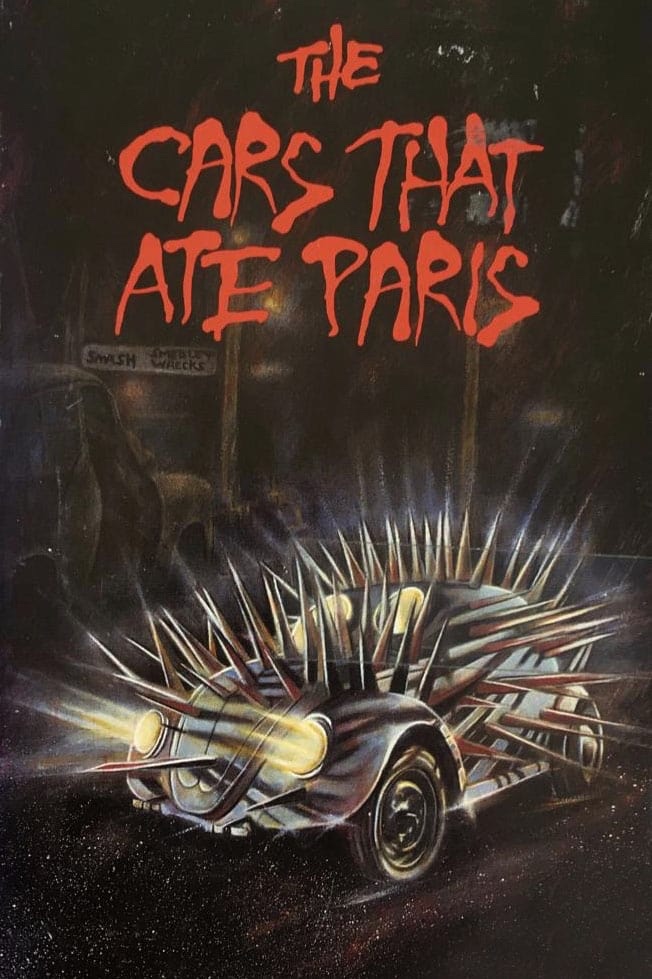
I expected a movie with a title like The Cars That Ate Paris to be equal parts Christine and Godzilla. Instead, Peter Weir’s small-town Austrailian horror film is more like a mix between Mad Max and The Wicker Man. The residents of the fictional town of Paris, New South Wales set life threatening traps for passing motorists deliberately causing automobile accidents. Local emergency responders determine whether the survivors will be helpful additions to their community and if not, they’re either murdered or lobotomized.
Our protagonist Arthur, is of the lucky few selected for assimilation. Arthur struggles acclimating to the odd Parisian customs like the normalized roaming gang of wasteland demolition derby cars or the aforementioned systematic murdering of outsiders. After several unenthusiastic escape attempts, Arthur submits to his captors and agrees to stay in Paris indefinitely. He’s even given a job as a traffic enforcement officer.
This newfound authority puts Arthur at odds with the car gang, who dislike outsiders telling them where to park. This conflict erupts in the all-out destruction of Paris when the car gang crashes the Founder’s Day costume party. Arthur and the other residents scatter, collect their precious possessions, and escape the town, leaving the Mayor alone in the rubble.
The Cars That Ate Paris is unique if not exciting or inteligible. While the residents salvage car parts from the wrecks they cause, it’s never explained why or how they profit from exchanging human lives for mufflers. While I am staunchly critical of films that disregard believability in favor of excitement, I’ll give The Cars That Ate Paris a break because the stakes are so incredibly low. If you’re audacious enough to call your movie The Cars That Ate Paris, or I Bought a Vampire Motorcycle or Snakes on a Plane, then your enthusiasm for absurdism earns exemption from my scrutiny. I am merciful and benevolent.
Terry Camilleri’s performance as Arthur is a wonderfully awkward thing to behold. Far from a typical protagonist, Camilleri’s Arthur is a meek and timid man whose aversion to conflict makes him easy to intimidate and bully into compliance. He spends most of The Cars That Ate Paris being coaxed into passivity. Even at the climax, Arthur is denied a chance at heroism, opting to escape his torment by simply driving away, going no faster than the speed limit, eyes fixed ahead, hands at ten and two. Imagine if Alex DeLarge spent the entirety of A Clockwork Orange as the effete brainwashed puke he becomes.
Directed by the man who helmed The Truman Show and Dead Poets Society: The Cars That Ate Paris is a delightfully odd novelty. For me, it is a glimpse into the Australian New Wave brought to us by our friends at The Criterion Channel. I am an Australian cinema neophyte, but I’m charmed by the strong sense of Australian identity I get from the few I’ve seen. I am excited to eventually crack into more Australian films like Wake in Fright, Picnic at Hanging Rock, and The Chant of Jimmie Blacksmith with the hope of further sneaking a peak at Australian life in the 1970s.
The Cars That Ate Paris‘ cinematography is typical of low budget 70s films but what really stands out about the production are the derby cars. Each one with its individual paint jobs and accessories give the nightmarish gang a personality like if someone installed a combustion engine inside The Warriors. Monstrously modded vehicles are especially common in the Mad Max series but stand out in The Cars That Ate Paris as a separate but equally Australian creation.
Categories

 Quarantined Critic