
Spider-Man: Across the Spider-Verse (2023) July 3rd, 2023
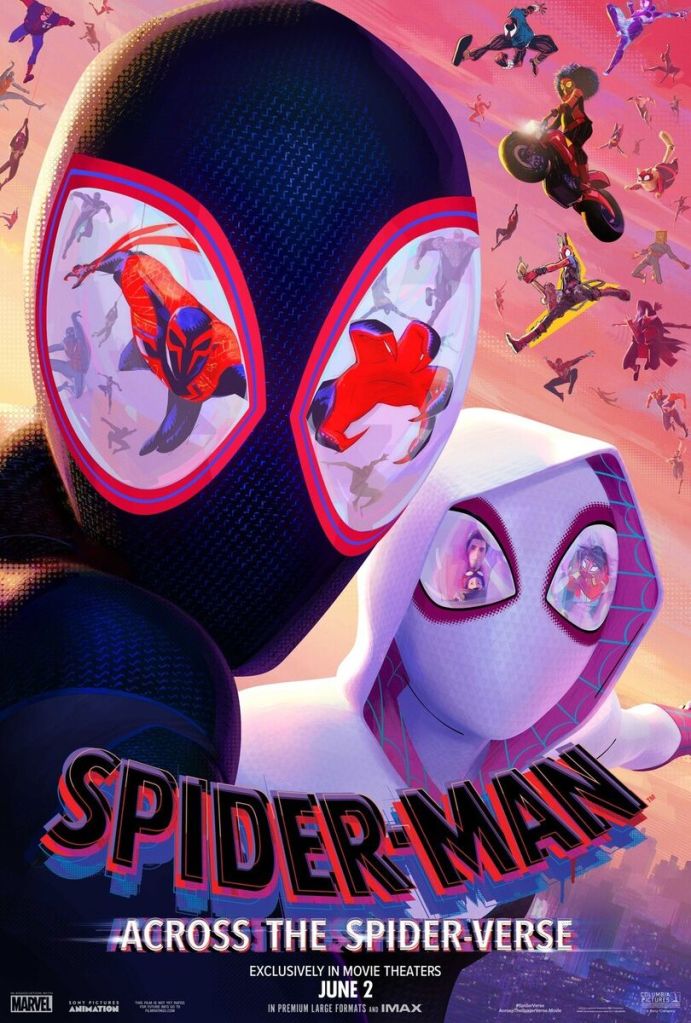
Spider-Man: Across the Spider-Verse, the highly anticipated sequel to 2018’s Spider-Man: Into the Spider-Verse, left me dissatisfied. I feel like I’d been promised a gourmet meal prepared by my favorite chefs (Lord and Miller) but was instead served their reheated leftover lasagna. Colorful and layered, yes. New and fresh, no. My hopes were especially high because Lord and Miller have a great track record of following up their smash hits with strong sequels (22 Jump Street, The Lego Movie 2: The Second Part, and Cloudy with a Chance of Meatballs 2 which I’m including on good faith because I haven’t seen it or its predecessor). For me, their streak ended with Spider-Man: Across the Spider-Verse.
I’ve noticed a trend in my recent initial movie reactions. My first response to Thor: Love and Thunder was writing off my initial criticisms as nothing more than ‘super-hero fatigue’. I thought I must just be done with the genre. Guardians of the Galaxy Vol 3. cured me of that disillusion and reaffirmed that my judgment of Thor: Love and Thunder was not influenced by some trendy buzzword but by the film’s own merits. I had the same initial reaction to Spider-Man: Across the Spider-Verse, I wondered if I had ‘multiverse fatigue’? One could argue the entertainment market is flooded with multiverses at the moment. Here’s a quick list of the recent multiverse movies/tv shows I can recall just off the top of my head: Rick and Morty, Loki, Doctor Strange in the Multiverse of Madness, Spider-Man: No Way Home, The Lego Movie, The Lego Movie 2: The Second Part, Everything Everywhere All At Once, the Crisis on Infinite Earths overarching storyline on the CW’s Arrowverse shows. One could even argue a couple of die rolls in a decade-old episode of Community set this whole movement in motion (more on that later). I would probably entertain this notion for longer if I hadn’t just seen and loved The Flash, another multiversal superhero epic.
Let’s start with the positives, Spider-Man: Across the Spider-Verse drops us back in Miles Morales’ world where he’s still a teenager juggling his personal responsibilities with his superhero obligations. A new villain named Spot, who looks like a Dalmatian man with a normal human head (I hope this doesn’t awaken anything in me), can create black holes in spacetime which he can punch, kick, and travel through has arrived to prove himself as Miles’ arch-nemesis. Spot suggests his transformation from particle physicist began at the Spider-Man: Into the Spider-Verse climax when he was caught in the fallout after Miles and the other Spider-People activated a particle collider to stop the Kingpin and Doctor Octopus from doing the bad thing. After receiving a spider-trouncing from Miles, Spot (voiced by Jason Schwartzman) feels underpowered and embarassed enough to pursue recreating his collider accident in other dimensions where he can double, triple or even infinately increase his power levels.
This is the main underlying threat in a movie that’s doing too much, but I’ve got to say I loved the way they used Spot. Look, there are certain characters in comics that everyone knows are jokes. They’re the goofiest and dumbest gimmicky characters who showed up briefly a long time ago to fill in an issue but never took off the way a Doctor Octopus or Magneto did. If you want some good examples please Google image search Typeface comics, Porcupine comics (he also appeared in the Disney+ She-Hulk series), or Banjo (a Spider-Man villain who hates it when you PICK on him). I know Spot had some recent success in more current comics but I had assumed he was just going to stay a dumb goofy gimmick character forever because they were never going to put him in a movie. Oh boy, how grateful I am that wasn’t the case, I am so grateful Sony took the chance on an obscure goofy character like Spot because he brings a lot of quality to Spider-Man: Across the Spider-Verse. Not only is it fun to see a starkly black-and-white character contrast with the overstimulatingly colorful animation style but his powers could believably lend themselves to a multiversal story. I never thought it would happen but here it is, great job.
While Spider-Man: Into the Spider-Verse was a stylized creative masterpiece its predecessor does too much of the same and overcomplicates most shots. Part of the original inspired design was a layered look seemingly equally inspired by the halftone effects of old paper comic books and the layered blocky style of NYC 80s street graffiti. Unfortunately this time in Spider-Man: Across the Spider-Verse the effect is disrupted by overly jerky camera movements and fast edits inducing mild motion sickness. Sometimes it felt like watching a 3D movie without glasses, and no one wants that.
Spider-Man: Into the Spider-Verse won a well-deserved 2019 Academy Award for Best Animated Feature on the strength of its unique animation style and captivating plot. 5 years later the sequel’s a blurry Xerox without the guts to tell a complete story in 2 hours and 20 minutes. In case you didn’t know, Spider-Man: Across the Spider-Verse is one of those multipart sequels that ends with a ‘to be continued’ slate and an IOU for a conclusion. I fully expected this franchise to spawn a third and maybe more movies so don’t get it wrong, that’s not the problem. The problem is Spider-Man: Across the Spider-Verse didn’t have the decency to include a ‘Part 1’ in its subtitle. Harry Potter and the Deathly Hallows: Part 1, Mission: Impossible – Dead Reckoning Part One, and The Hunger Games: Mockingjay – Part 1 all showed their audiences the courtesy of including this information upfront and in the title. What makes matters worse is we were probably only 30 minutes away from a satisfying resolution and tease for the third installment. Instead, there’s just disappointment and an apathetic malaise about the third part. Why should I care?
Maybe you really enjoyed the story thus far and felt like the ending was a perfect cliffhanger, to some extent that’s a personal decision between you and your god. Here are the reasons I felt like the plot failed us all. Derivative repetition. Aside from Spot’s fun representation I only saw shades of reused devices and plot elements. There are many plot threads woven together in Spider-Man: Across the Spider-Verse that build a sort of web of interconnected stakes. The main plot involves Miles gaining access to an elite strikeforce of multiversal Spider-People who travel around fixing tears in the multiverse and’re led by Miguel O’Hara AKA Spider-Man 2099.
If you’ve seen The Flash, Loki, or Quantum Leap you’re familiar with this ubiquitous multiversal trope: You can’t change important events in the timeline without catastrophic repercussions. Spider-Man: Across the Spider-Verse plays it off like they’re doing something different by renaming these significant events as ‘canon events’. It’s all the same thing, we’ve seen this all before. What makes this even more derivative is the inclusion of Miguel O’Hara as the point man for the interdimensional spider-squad. See, back in 2006 Marvel Comics published their 75th issue of a series called Exiles. Exiles was a strike team of familiar character variants who traveled across dimensions to fix ‘canon events’ and repair the multiverse with the aid of a wrist-mounted transport system called the Tallus. Sound familiar? Three years into their run they introduced a Spider-Man 2099 variant to their team in issue 75, he would become a valuable member of the team until he settled down with a Mary Jane of his own. Also, he died in the Spider-Verse comics but may also be alive through the magic of fiction. Shrug. The point is, I’ve seen much of this before.
The Miguel in Spider-Man: Across the Spider-Verse isn’t just the leader of the Spider-Clan he’s also sort of a subvillain. His commitment to protecting canon events is so strong that he’ll ensure the deaths of people close to the Spider-People because he believes those are immutable moments in their development. What is Spider-Man without tragedy after all? Miles rejects this notion and flees to what he believes is his home dimension before the end of the movie. Once there he reveals himself to be Spider-Man to his mother who has no idea what he’s talking about, because he didn’t return to his dimension but instead the dimension of the spider who bit him and gave him powers in Spider-Man: Into the Spider-Verse. I promise it’s not that confusing, in this universe there is no Spider-Man but there is another Miles Morales who’s taken up the mantle of The Prowler, the villainous alter ego of Miles’ uncle. This is the cliffhanger, will the evil mirrorverse Miles kill goodguy Miles and take his place in a universe where their father is still alive? Tune in next movie to find out. This could be a cool ending if both the good guy who turns out to be evil AND the alternative evil self weren’t both already used and fused into one plot point in the Lord and Miller movie The Lego Movie 2: The Second Part.
In The Lego Movie 2: The Second Part our hero Emmet meets an even more heroic action star character Rex Dangervest who seems to do everything Emmit can do but better. Rex is a galaxy-defending archeologist, cowboy, and raptor trainer whose creation combines the meta elements of various characters his voice actor Chris Pratt has played in other films. He’s also secretly a future version of Emmet who is later revealed to be the film’s main antagonist. This wouldn’t be such an obvious cop-out if Lord and Miller hadn’t written both The Lego Movie 2: The Second Part and Spider-Man: Across the Spider-Verse. This lack of originality and well-worn plot points reminded me of watching Denis Villeneuve’s Dune: Part One (notice the ‘Part One’? Saved that for right now) except that movie was the first part in a larger overarching epic, not a misleading sequel.
But we’ve never seen a huge group of Spider-People policing the multiverse before, surely that’s a completely original idea from Spider-Man: Across the Spider-Verse! Sorry, but obviously no. Let’s just look at The Council of Ricks from Rick and Morty, this trans-dimensional council of Rick Sanchezs pretty much manages the multiverse in the same way Miguel does with his spider-team. The difference is Rick Sanchez’s creator fully acknowledges the derivative nature of his creation as at least an amalgam of Reed Richards, Doc Brown, and himself Dan Harmon. Specifically, the Council of Ricks is a direct nod to the Interdimensional Council of Reeds as created by Jonathan Hickman during his run on Fantastic Four in 2009. These councils are all the same, all members are the same character, or in the case of Spider-Man: Across the Spider-Verse they’re all the Spider-People of their universes, and they all police interdimensional stuff/canon events/watevru wan’abi.
This stuff is abrasivly familiar but forgivable but for the itch. The itch in the back of my brain that wants to go over the meta origins of Miles Morales. September 23rd, 2010 the first episode of Community Season 2 titled Anthropology 101 airs. In the episode’s second shot, we see Donald Glover waking up, getting out of bed, and stretching while wearing Spider-Man pajamas. This references Glover’s failed online campaign to star as the new Spider-Man in Sony’s upcoming film series which would inevitably go to Andrew Garfield. Enter Marvel Comics writer Brian Michael Bendis who’d been writing Ultimate Spider-Man since 2000 and was nearing a point in the series when he planned to kill off his Peter Parker. Bendis decided to replace Parker with Miles Morales a new character inspired by the support Glover received from the online community and the Community writers. August 2011 Miles Morales makes his first appearance in Ultimate Comics: Fallout #4. October 2011 Community season 3 episode 4 Remedial Chaos Theory airs and brings the concept of multiverses into the normative collective consciousness. Meanwhile, Miles is a huge success and in 2015 the character debuted on the animated Ultimate Spider-Man show voiced by Donald Glover. Cut to 2017, Donald Glover portrays Aaron Davis, The Prowler, in Spider-Man: Homecoming suggesting the existence of Davis’ nephew Miles in the Marvel Cinematic Universe. 2018 Spider-Man: Into the Spider-Verse tells the oscar-winning story of Miles’ struggle with his criminal uncle and the help of various alternative universe’s Spider-People and directly references Community by recreating the shot of Donald Glover wearing Spider-Man pajamas. June 9th, 2021, Loki premieres on Disney + bringing the idea of the TVA into the mainstream Marvel Cinematic Universe. December 13th, 2021 Spider-Man: No Way Home unites the three major live-action Spider-Men in one adventure further exploring the impacts of the multiverse on the Marvel Cinematic Universe. May 2nd, 2022, Doctor Strange in the Multiverse of Madness directed by former Spider-Man director Sam Rami addresses the multiversal tears and hiccups from Spider-Man: No Way Home. Finally in 2023 with Spider-Man: Across the Spider-Verse, we get a wonderful easter egg of Donald Glover reprising his role as Aaron Davis in a stasis cage in the Interdimensional Council of Spider-People’s holding cells.
Community is the canon event. Without Community, we don’t get Miles Morales. Without Community, we don’t get the wave of multiversal stories. Without Community we don’t get Spider-Man: Into the Spider-Verse. In this way Community and its creator Dan Harmon, are both our hero and our villain. Without him, we don’t get Spider-Man: Across the Spider-Verse at all but with him, it is a bloated derivative film. Dan Harmon is Rex Dangervest. Dan Harmon is Miguel O’Hara. Dan Harmon is the Spider-Man: Across the Spider-Verse Alpha and Omega.
‘Nuff Said.
Categories

 Quarantined Critic